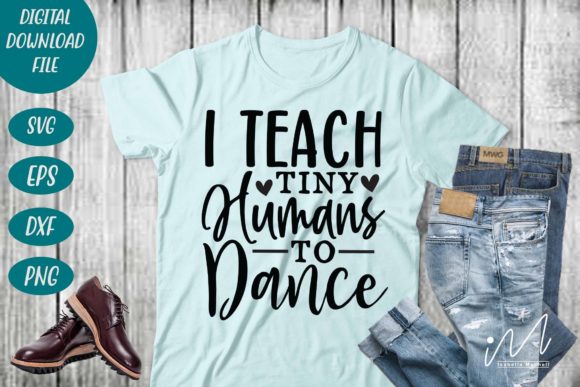
I Teach Tiny Humans to Dance Svg Review
As a designer who spends half my life troubleshooting thread tangles and the other half judging the aesthetic viability of vector shapes for real-world stitching, I approach every new digital asset with a healthy dose of skepticism. The market is flooded with generic clipart that looks fine on a screen but falls apart under the needle. That is why when I encountered I Teach Tiny Humans to Dance Svg, I didn’t just look at the preview image; I mentally mapped it out against various fabrics, hoop sizes, and end-use scenarios. This review breaks down exactly how this design performs when you move from the computer screen to the embroidery machine.
The First Impression: Mood and Visual Personality
The quote “I teach tiny humans to dance” carries an immediate emotional weight. It speaks directly to parents, dance instructors, and anyone involved in early childhood education. From a design perspective, the typography and layout need to balance whimsy with readability. In my experience, designs that rely too heavily on cursive or overly decorative fonts often struggle during digitization, leading to muddled lettering that loses its charm once stitched.
This embroidery file strikes a good balance. The visual personality is warm, inviting, and slightly playful without being chaotic. It creates a mood that feels perfect for personalized gifts and boutique merchandise. When I first laid eyes on the I Teach Tiny Humans to Dance Svg, I immediately thought of nursery decor and custom apparel for young dancers. The theme suggests movement and joy, which translates well into stitch work if handled correctly. It isn’t just text; it’s a statement piece that defines the wearer or the product owner’s identity.
Real-World Application: Where Does This Design Shine?
Let’s talk about practical use cases. I recently imagined preparing a batch of custom embroidered tote bags for a local dance studio’s open house. Using the I Teach Tiny Humans to Dance Svg on sturdy canvas totes felt like a natural fit. The design allows for a generous amount of white space around the text, which means it can be centered prominently or placed off-center for a more modern, asymmetrical look.
Beyond totes, this design is incredibly versatile for custom apparel. Picture a soft, heather-gray sweatshirt featuring this quote in contrasting thread colors. The combination of comfort wear and a heartfelt message appeals strongly to the craft business demographic, particularly those selling on platforms like Etsy. It also works beautifully as an embroidered patch intended for denim jackets or backpacks, adding a touch of personal flair to everyday items.
For the Etsy seller or small shop owner looking to expand their inventory, this design opens up several revenue streams. It fits seamlessly into categories like baby showers, where a onesie or burp cloth featuring the quote serves as a memorable keepsake. It is also ideal for holiday embroidery projects, serving as a thoughtful gift for dance teachers or proud parents. The versatility of the I Teach Tiny Humans to Dance Svg means it can be adapted for kitchen towels or pillow covers in a dancer’s home, creating a cohesive brand aesthetic across multiple products.
Material and Fabric Considerations
Not all fabrics are created equal, and the success of your embroidery project often depends on what you stitch onto. For this specific design, I recommend using stable, medium-weight fabrics. Cotton blends, fleece, and canvas provide the necessary structure to hold the stitches without puckering. If you are working with textured fabrics like bouclé or heavy waffle weaves, you may find that the details get lost. Similarly, while stretchy knits can be used, they require careful hooping and possibly a tear-away stabilizer to prevent distortion.
When considering color palettes, contrast is key. On dark fabric backgrounds, light thread colors will make the quote pop, ensuring high visibility and legibility. Conversely, on light fabrics, darker threads provide a sharp, professional finish. I always advise testing thread color combinations before committing to a full run, especially if you are aiming for a subtle, tonal look.
Potential Pitfalls and Areas for Caution
Even the best designs have limitations. One area where designers must exercise caution is with small hoop sizes. If you attempt to digitize or stitch this design in a very small hoop, the text may become cramped, and any decorative elements could merge into a blob. Always check the hoop size requirements relative to your intended final product size.
Another critical factor is stitch density. While the provided formats (SVG, DXF, EPS) allow for resizing, they do not automatically adjust stitch density. If you scale the I Teach Tiny Humans to Dance Svg up significantly, ensure that the underlying digitization (if converting to PES or similar) does not result in excessive thread usage, which can lead to stiff, uncomfortable garments. Conversely, scaling down too much may cause thin lines or small letters to disappear entirely.
Textured surfaces like caps or curved hat fronts present another challenge. The curvature can distort the perception of the text, making it harder to read from certain angles. For these applications, I suggest keeping the design simple and avoiding overly intricate details. Additionally, if you plan to wash the finished product frequently, such as with baby clothes or kitchen linens, ensure that the stabilizer is fully removed and that the stitches are secure to prevent unraveling over time.
Technical Notes for the Discerning Designer
Before you import this digital embroidery file into your software, there are a few technical steps every professional should take. First, inspect the vector paths in your appropriate software. Check for overlapping nodes or unnecessary anchor points that could complicate the cutting or stitching process. Since the product description mentions SVG, DXF, and EPS formats, remember that these are primarily cut files. If you intend to use them for machine embroidery, you will likely need to convert them or trace them into a format compatible with your embroidery machine, paying close attention to how the satin stitch, fill stitch, and running stitch are applied.
Always test the design on scrap fabric that matches the weight and texture of your final material. This step is non-negotiable. It allows you to assess thread tension, stabilizer performance, and overall visual impact. I also recommend creating black-and-white mockups to evaluate the contrast and readability of the text independent of color distractions. This helps ensure that the design maintains its integrity regardless of the thread colors chosen.
Final Verdict: Is It Worth Adding to Your Assets?
In conclusion, the I Teach Tiny Humans to Dance Svg is a strong addition to any designer’s library, particularly those focused on the crafts and graphics niche. Its emotional resonance and thematic clarity make it highly marketable for personalized gifts, boutique branding, and commercial embroidery projects. However, success lies in execution. By carefully selecting fabrics, managing stitch density, and conducting thorough tests, you can transform this vector shape into a stunning finished product that delights customers and builds trust in your handmade brand.
Whether you are creating a single personalized gift for a friend or mass-producing small shop products for online sale, this design offers a reliable foundation for creativity. Just remember to verify licensing terms before selling finished items, and always prioritize quality control in your production process. With the right approach, this design can elevate your embroidery project from a simple craft to a professional, desirable commodity.